Firebase vs Supabase in 2026: Which Backend Actually Fits Your App
The Firebase vs Supabase decision used to get simplified as "NoSQL vs SQL." That framing is dated. The real 2026 comparison is an open-source Postgres platform (Supabase) versus a Google-ecosystem backend-as-a-service that now also offers Postgres through Data Connect (Firebase). Picking correctly depends less on which database model you prefer and more on what kind of app you're building and how predictable you need your bill to be.
Architecture
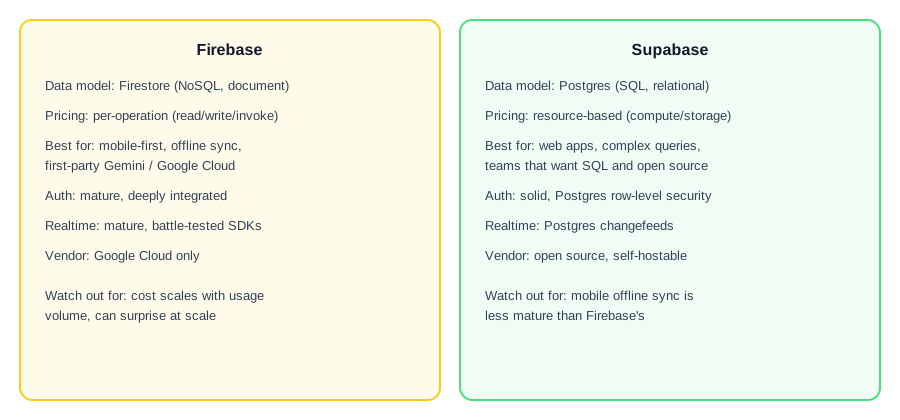
Firebase is service-oriented: Firestore, Auth, Cloud Functions, Hosting, and Data Connect are each independently managed services with their own SDKs and their own mental model. That separation is a feature when you want managed, mature, individually-scaling pieces, and friction when you want one consistent data model across your whole app.
Supabase is Postgres with managed auth, storage, realtime, and edge functions layered on top of a single source of truth. Everything — including auth users — lives in tables you can query directly with SQL, join across, and inspect with any Postgres tool. If your team already thinks in relational terms, this collapses a lot of "which service do I call for this" decisions into "which table do I query."
Pricing behavior, not just price
The bigger practical difference isn't which one is cheaper in the abstract — it's how each one bills. Firebase charges per operation: each read, each write, each function invocation. Supabase charges for resources: database size, monthly active users, bandwidth, compute. For a read-heavy app doing 10 million reads a day, that difference alone can separate a $50-100/month bill (Supabase) from $500-1,500/month (Firebase) for equivalent workloads, because Firebase's per-read model punishes exactly the access pattern most content-heavy apps have.
That doesn't make Firebase the wrong choice — it makes its pricing model something you need to model against your actual access pattern before committing, not after the first surprising invoice.
Where Firebase still wins
Mobile-first apps with serious offline requirements are still Firebase's strongest case. Firestore's offline persistence and conflict resolution are mature in a way Supabase's Postgres-based realtime layer doesn't yet fully match for complex offline-first mobile scenarios. If you're building a Flutter or React Native app that needs to work reliably on a subway with intermittent connectivity and sync cleanly when it resurfaces, Firebase's SDKs have years of edge cases already handled.
Firebase also wins on Google ecosystem integration — first-party Gemini API access, Google Cloud infrastructure, and Data Connect for teams that want Firebase's operational model with a relational database underneath.
Where Supabase wins
Any app with genuinely relational data — multi-table joins, reporting queries, anything you'd naturally reach for SQL to express — is more naturally modeled in Supabase than flattened into Firestore's document structure. Complex queries that would require denormalizing data or running multiple round-trips in Firestore are a single SQL query in Supabase.
Supabase's S3-compatible storage API and built-in image transformation (resize, crop, convert via URL parameters) remove the need for a separate image processing service, which matters for content-heavy apps. And its Q1 2026 addition of agentic AI compute scaling — dynamically resizing compute for embedding generation and vector search — means RAG and AI-search features run on the same infrastructure as the rest of the app, without standing up a separate vector database.
Supabase being open-source Postgres also means no lock-in to a single vendor's proprietary query model — you can self-host, migrate to any Postgres-compatible host, or run it alongside existing SQL infrastructure your team already operates.
A practical decision framework
If you're building a mobile-first app with offline-first requirements as a core feature, or you're already deep in the Google Cloud/Gemini ecosystem, Firebase remains the stronger default. If you're building a web application with relational data, want SQL as your primary query interface, or care about predictable costs at scale and avoiding vendor lock-in, Supabase is the better fit for most projects started today.
The honest answer for a lot of teams is that either works for an MVP — the real cost of the wrong choice shows up six months in, either as a Firestore data model that's been awkwardly denormalized to avoid N+1 reads, or as a Supabase offline-sync workaround that Firebase would have handled for free. Model your actual access pattern and your offline requirements before picking, not your database philosophy.